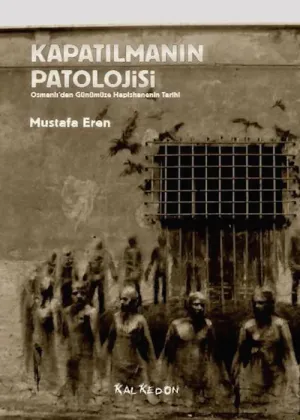
This page presents an English-language overview of a book published only in Turkish. See the publisher’s page for the original edition.
Title: The Pathology of Confinement: A History of the Prison from the Ottoman Empire to the Present
Author: Mustafa Eren
Publisher: Kalkedon Yayıncılık
Cover design: Şahan Yatarkalkmaz
Publication date: May 2014
Pages: 345
ISBN: 6054979110
Since 2000, alongside the construction of F-type prisons, Turkey has been undergoing a substantial process of rebuilding around the question of imprisonment. As prisons are opened, closed and reorganized, an architectural transformation is under way: ward-based prisons are being phased out in favor of the “room system” as the dominant architectural model. Two further developments help make sense of this rebuilding process: a rising tide of criminalization, and a corresponding increase in the prison population. For someone who, like the author, has spent a long period as an involuntary participant-observer of this system, offering a coherent view from the past to the present, and putting the pathological structure of prisons up for discussion, was an unavoidable obligation and responsibility.
The book you are holding is organized in three parts. The first part examines the concepts used in discussing prisons and attempts to sketch a general picture of Turkey’s prisons and prisoners. The second part argues, on the basis of shifts in architecture, law, discourse and practice, that the history of prisons from the Ottoman Empire to the present can be divided into three periods. The third part turns to the “pathology” that gives the book its title, arguing that prisons are pathological institutions and offering a critique of the “rehabilitation” approach on that basis.
If this book can make even a modest contribution to the discussion of the pathological structure of prisons — and to the critique of Turkey’s prisons in particular — it will have succeeded.
Mustafa Eren