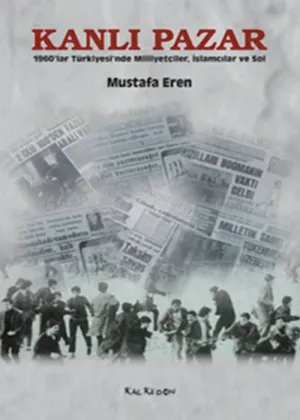
This page presents an English-language overview of a book published only in Turkish. See the publisher’s page for the original edition.
Title: Kanlı Pazar – Nationalists, Islamists and the Left in 1960s Turkey
Author: Mustafa Eren
Publisher: Kalkedon Yayıncılık
Cover design: Şahan Yatarkalkmaz
Publication date: February 2012
Pages: 284
ISBN: 978-605-4511-43-3
The book can be read as two parts. The first part lays out Turkey’s political panorama from the 1960s into the 1970s. The author shows that the political fault lines still visible in Turkey today largely took shape in this decade: it is in this period that the terms “right” and “left” enter Turkish political vocabulary in earnest, that the nationalist-conservative camp splits into nationalists and Islamists, that the leftist youth movement divides between the “national democratic revolution” (MDD) and “socialist revolution” (SD) currents, and that a nationality-based split emerges with the founding of the Revolutionary Eastern Cultural Hearths. It traces the leftist youth’s transformation from Kemalism to socialism, and from socialism to radical revolutionary movements, together with the major actions carried out from the 1960s into the 1970s.
The second part recounts the “Bloody Sunday” (Kanlı Pazar) massacre of 16 February 1969. When the US Sixth Fleet anchored off Dolmabahçe, leftist/socialist youth organized a protest march; right-wing organizations attacked the march in a coordinated assault. During the march from Beyazıt to Taksim Square on 16 February, clubs were distributed from trucks, blue ribbons were pinned on attackers’ lapels so police would not mistakenly detain them, and the attack left two people dead and dozens injured. Kanlı Pazar was the first in a series of mass killings that would recur throughout the 1970s; a number of figures who remain prominent in Turkish political life today were among the rightist youth involved in the massacre, and the book traces their trajectories from the 1960s onward. The book is, at its core, a call for the nationalist, Islamist and leftist political traditions to reckon with their own histories through the Kanlı Pazar massacre.