Author’s Note – 2026
I wrote the article below in 2017 after the Turkish government revived the proposal to introduce mandatory prison uniforms (Tek Tip Elbise – TTE). At the time, President Recep Tayyip Erdoğan explicitly referred to the example of Guantánamo and declared his intention to implement the measure. Shortly thereafter, Decree Law No. 696, issued on 24 December 2017, introduced a regulation requiring detainees and prisoners convicted of or charged with offences under the Anti-Terror Law to wear mandatory prison uniforms when taken outside correctional facilities.
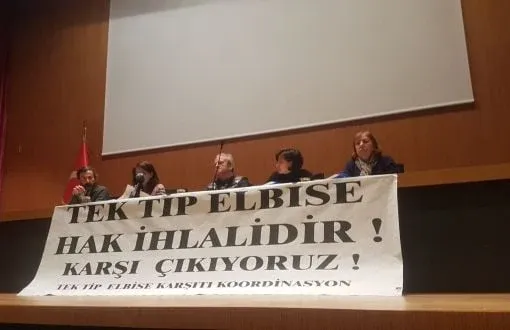
The proposal prompted strong opposition from numerous civil society organisations. In response, the Coordination Against Mandatory Prison Uniforms was established through the participation of various rights organisations, which jointly campaigned against the regulation. Owing to sustained public opposition, the measure was never implemented in practice. It was subsequently annulled by the Constitutional Court, which, in its judgment No. 2023/222 of 27 December 2023, held that the regulation “did not satisfy the requirement of necessity” and was “contrary to the Constitution.“¹
Despite the years that have passed, I believe that the article below remains relevant. It goes beyond a critique of mandatory prison uniforms as a specific policy and examines the political and symbolic purposes such measures are intended to serve, while tracing their historical precedents in Turkey. For this reason, I present it once again to readers, accompanied by this brief historical note.
Note: The original Turkish version of this article was first published on Bianet on 26 August 2017.
¹ Bianet, “Constitutional Court Annuls the Regulation Introducing Mandatory Prison Uniforms in Prisons,” 17 April 2024. Also see: Official Gazette of the Republic of Türkiye, 17 April 2024.
The debate over mandatory prison uniforms (MPUs) resurfaced after one of the defendants appeared at a hearing in the trial concerning the 15 July coup attempt wearing a T-shirt bearing the word “hero.” Government officials and the pro-government media regarded the message conveyed through the T-shirt as hostile, characterised it as terrorist propaganda, and brought mandatory prison uniforms back onto the political agenda as a way of eliminating this form of expression altogether.
In a speech delivered on 16 July 2017, President Recep Tayyip Erdoğan stated:
“Just as the Turkish nation is compassionate towards those who ask for mercy, it is equally severe towards those who persist in their treachery. While those traitors rot behind prison walls, they will have plenty of time to think about these things. These are their good days for now. I recently discussed this with our Prime Minister. From now on, just as in Guantánamo, they should also appear before the courts wearing mandatory uniforms.”
The following day, government spokesperson Numan Kurtulmuş made the following remarks during a press conference after the Council of Ministers meeting:
“Members of terrorist organisations, especially FETÖ, will be required to appear before the courts wearing mandatory uniforms. We will share the details with you once this work has progressed further.
Since the work has not yet been completed, I cannot provide the details. However, our Ministry of Justice has placed this issue on its agenda and will finalise the necessary work very quickly.
[Regarding the T-shirt bearing the word ‘hero’] Even before this T-shirt incident, the fact that they appeared before the courts wearing suits offended our nation. Some of them were members of the team that attempted to assassinate our President; others belonged to the band of outlaws who martyred our people using the aircraft and helicopters they launched from Akıncı Air Base.
Our courts are open and operate in accordance with the principles of the rule of law. Nevertheless, bringing these defendants before the courts wearing mandatory uniforms is the more appropriate course of action. The Ministry of Justice will carry out the necessary work.“
These statements were followed by further remarks from President Erdoğan, in which he described the colour, design and anticipated implementation of the uniforms:
“(…) We are now introducing mandatory uniforms. As for the colour, you know the colour of almonds? It will be a darker shade of the almond kernel. There will be two types. One will be a jumpsuit, the other a jacket and trousers. Those involved in the coup attempt will wear the jumpsuit, while the terrorists will wear the jacket and trousers. From now on, they will no longer be allowed to come dressed as they wish. This is how they will be presented to the whole world.” [1]
He later added:
“Work on the mandatory uniforms is progressing rapidly. Around 70,000 uniforms are being prepared. The uniforms will be worn during the judicial proceedings.” [2]
According to subsequent reports citing the Ministry of Justice, 70,000 mandatory uniforms had already been prepared and, moreover, had been sewn by prisoners in prison workshops. [3] With the uniforms ready, all that remained was for the button to be pressed.
An Attempt at an Analysis of Mandatory Prison Uniforms
The practice of mandatory prison uniforms requires a detailed and analytical assessment. Although it is not possible to undertake such an assessment within the scope of this article, the following observations seek to identify the main themes and provide signposts for a more comprehensive analysis.
- Mandatory prison uniforms are a restriction. They impose a restriction by prohibiting prisoners from wearing the clothes of their own choosing.
- Mandatory prison uniforms are an imposition and a fait accompli. Prisoners are told: “You may not wear the clothes you want. We have decided what you should wear, and this is what you will wear.”
- Mandatory prison uniforms represent the complete denial of prisoners’ agency. Through mandatory uniforms, prisoners are told that they no longer have authority over their own lives.
- Mandatory prison uniforms are a separation. Mandatory prison uniforms signify that imprisonment alone is not considered sufficient, that separating prisoners from society merely in spatial terms is deemed inadequate. Already physically separated from society through confinement, prisoners are subjected, through mandatory uniforms, to further and deeper forms of emotional and symbolic separation.
- Mandatory prison uniforms are a nullification. Clothing is one of the ways through which people express their identity, personality, profession and sense of belonging. Even after imprisonment, prisoners can continue, at least to some extent, to express and make visible their identity, personality and affiliations through the clothes they wear. Taking away their clothing and dressing all prisoners in identical uniforms aims to reduce them to zero.
- Mandatory prison uniforms constitute a declaration of guilt. Through mandatory uniforms, prisoners are not merely reduced to zero. They are publicly defined not as citizens who are subjects of rights, but as criminals belonging to the penal system, and this new status is imposed upon them.
- Mandatory prison uniforms stigmatise. By wearing a mandatory uniform, the judgement and label of “criminal” are attached to the prisoner’s body; the body itself becomes the bearer of that judgement. In this way, mandatory prison uniforms function as an instrument of stigma. Even where the person wearing the uniform is merely a detainee whose trial is still ongoing—and who must therefore be presumed innocent under the principle of the presumption of innocence—the uniform separates that person from the rest of society and places them outside what is considered legitimate and respectable. This exclusion is more than mere separation. Those pushed outside are symbolically redefined as “terrorists,” “traitors,” or “looters,” thereby excluding them from the category of the citizen as a subject of rights. (In this regard, one should recall Giorgio Agamben’s discussion of homo sacer and Judith Butler’s reflections on those cast outside the category of the human.)
- Mandatory prison uniforms are instruments for securing obedience to authority. The message conveyed to the prisoner who is forced to wear a mandatory uniform is clear: “You are now a criminal. Your life outside has remained outside together with your clothes. You no longer have a will of your own; you are subject to mine. You no longer have rights; you have obligations. You must do whatever I require.” Within the universe of the prison, correctional officers are invested with authority by means of their uniforms, whereas prisoners are stripped of all authority through mandatory prison uniforms and reduced to a position of obedience.
It is certainly possible to develop this analysis further by grouping these observations under broader themes and examining them in greater detail. Nevertheless, I believe these points are sufficient to demonstrate both the analytical possibilities of such an approach and the extent to which mandatory prison uniforms constitute a deeply coercive imposition within the prison system.
The History of Mandatory Prison Uniforms in Turkey
It is well known that mandatory prison uniforms came onto the agenda following the military coup of 12 September 1980, that they were enforced through violent repression, and that they gave rise to widespread resistance. Much less is known, however, about their earlier history. In fact, mandatory prison uniforms have a history that predates 1980 and extends back to the Ottoman Empire. One of the earliest known documents dates from 1902. An addendum to a memorandum (tezkere zeyli) issued that year stated that, as part of the reorganisation and reform of prisons, prisoners should be required to wear mandatory uniforms so that they could neither obtain weapons nor evade capture easily in the event of escape. It further described mandatory prison uniforms as one of the most important measures to be taken in the reform of prisons.[4]
Following this initiative, mandatory prison uniforms acquired official status with the Prison Regulation (Nizamname) issued in 1916. According to the Regulation, those sentenced to more than six months’ imprisonment were required to wear mandatory uniforms. Despite this provision, however, the policy was abandoned on financial grounds.[5]
This Regulation, which formally introduced mandatory prison uniforms, is noteworthy for other reasons as well. At a time when prison reform had already been on the Ottoman agenda for several decades, the General Directorate of Prison Administration (Hapishaneler İdare-i Umumiye Müdüriyeti) was established within the Ministry of the Interior (Dâhiliye Nezareti) in 1911–1912. When the Directorate became ineffective due to the Balkan Wars, it was reorganised in 1913–1914. In 1916, Dr Paul Pollitz, who had served as director of Düsseldorf-Derendorf Cellular Prison since 1906, was appointed Inspector General of Prisons (Hapishaneler Müfettiş-i Umumisi) so that the reform process could be carried out under experienced leadership.
After taking office, Pollitz visited numerous prisons, commissioned a survey, prepared reports and examined prison regulations in several European countries, thereby paving the way for the drafting of a new prison regulation. On the one hand, this Regulation introduced into the Ottoman Empire contemporary European debates concerning the execution of criminal sentences; on the other, as a consequence of this new penal philosophy, it incorporated both compulsory prison labour and mandatory prison uniforms.
A document prepared by the Directorate of Imperial Buildings and Prisons (Dâhiliye Nezareti Mebânî-i Emîriyye ve Hapishaneler İdaresi Müdüriyeti) explained the rationale behind the new Regulation as follows:
With this Regulation, irrational methods such as confining offenders, isolating them from society, and preventing them from engaging in productive activity would be abandoned. Instead, prisons would cease to be centres of idleness and misery. Industrial and agricultural activities would be organised in accordance with the principles of political economy so that prisons could cover their own expenses and thereby reduce, as much as possible, the burden on the state treasury. Since idleness and inactivity exert harmful effects on both mind and spirit, leading to foolish wrongdoing, offenders would therefore be directed towards labour and productive work.
As was the case with the architectural reform of prisons, the implementation of mandatory prison uniforms during the Ottoman period ultimately proved impossible for financial reasons. Both the problems and the objectives associated with this policy were inherited by the Republic of Turkey.
From the 1950s onwards, prison architecture in Turkey began to be constructed according to standardized designs. The implementation of mandatory prison uniforms, however, had to wait until 1980.
Following the military coup of 12 September 1980, responsibility for the prison system was entrusted to Commander Nevzat Bölügiray. Bölügiray had served as Commander of the Martial Law Command covering the provinces of Adana, Kahramanmaraş, Gaziantep, Adıyaman, Hatay and Mersin between 31 August 1979 and 20 October 1980, and later, between 10 December 1980 and 2 September 1983, as Head of the General Staff’s Martial Law Coordination Office. Convinced that prisons before the coup had become “places through which anyone could come and go” and “liberated zones,” one of his first initiatives was to establish a working group under his own chairmanship. Alongside representatives of the Ministry of Justice and the Ministry of the Interior, the group also included deputy undersecretaries and deputy directors general from the Ministries of Education, Health, Public Works and Settlement, as well as representatives of the Gendarmerie General Command. Among the issues placed on the agenda by this working group were cell-type prisons and mandatory prison uniforms.
As one of the first steps towards the introduction of cell-type prisons, Special-Type Prisons (Özel Tip Hapishaneler)—in which traditional wards were divided into smaller rooms—began to be constructed. On 2 August 1983, an amendment was introduced to the Regulation on the Administration of Penal Institutions and Detention Houses and the Execution of Sentences. The amendment added a new category to the classification of prisoners: “those convicted of crimes of anarchy and terrorism.” It further provided that prisoners in this category would serve their sentences in prisons consisting of single- and three-person cells. Through this amendment, one category of prisoners was officially designated as “anarchists” and “terrorists,” and it was formally declared that they would be subjected to a separate regime of imprisonment.
Bölügiray defended the introduction of mandatory prison uniforms with the following words:
“Mandatory prison uniforms, as in many Western countries, were considered necessary in order to make escapes more difficult and to facilitate prisoner counts and the maintenance of discipline.” (Bölügiray, 2002: 184)
The policies implemented on the basis of these decisions resulted in the violence and resistance that marked prisons such as Diyarbakır, Mamak and Metris during the period following the 12 September coup.
One day, Colonel Raci Tetik, who was in charge of Mamak Prison during this period, assembled all prisoners in the prison yard for roll call and declared to them: “You will cease to be human and return to humanity.” Mandatory prison uniforms were introduced as one of the instruments through which this transformation was to be imposed. With their heads shaved and mandatory uniforms forced upon them, prisoners were to be erased in the same way that words written in pencil are erased with an eraser, so that something new could be written in their place. (The mechanisms through which mandatory prison uniforms function were discussed at the beginning of this article.)
Following the introduction of mandatory prison uniforms after the 12 September coup, prison operations were carried out in numerous prisons during which all clothing except prisoners’ tracksuits was confiscated. Prisoners were forcibly made to wear mandatory uniforms; those who refused were left wearing only their underwear for months and were even brought before the courts in that condition. Numerous hunger strikes lasting for days were organised in protest, demanding an end to the coercive measures and the withdrawal of mandatory prison uniforms. On 11 April 1984, after four prisoners died following a 75-day death fast, the policy of coercion gradually began to retreat, and in 1988 the practice of mandatory prison uniforms was abandoned altogether.
Conclusion
In conclusion, mandatory prison uniforms have no defensible aspect from a legal, sociological, psychological, humanitarian or moral perspective. It is evident that they violate the presumption of innocence, are used as an instrument of criminalisation, and serve as a means of depersonalisation. Although the idea first emerged during the Ottoman period, the principal attempt to implement it took place in Turkey following the military coup of 12 September 1980. After encountering determined resistance from political prisoners, the policy was eventually abandoned.
The attempt to revive mandatory prison uniforms today—particularly by legitimising them through reference to Guantánamo, a detention regime that has attracted worldwide criticism, while ignoring both the scholarly literature and Turkey’s own historical experience—reflects a profound failure of judgment. One can only hope that policymakers will quickly recover from this lapse, and that all human rights defenders will maintain their determined opposition to this initiative.
Testimonies from the Period of the 12 September Military Regime
Sinan Kukul
On 16 January [1984], after the prisoners who were to appear in court had been handcuffed, soldiers attempted to force them into mandatory prison uniforms. Although their hands were cuffed behind their backs, the political prisoners tore apart one another’s uniforms in the exercise yard of Block A, where they were being held before being taken to court. At the same time, they chanted slogans declaring that they would never wear the uniforms. The prison administration did not remain indifferent to the tearing of the uniforms and the slogans in the yard before the hearing. Soldiers entered the yard and beat the prisoners—whose hands were still cuffed behind their backs—with kicks and punches. Three detainees in the DS trial lost consciousness because the handcuffs had been fastened so tightly. They received no medical treatment. Even their handcuffs were not loosened for a long time. Because they had torn the uniforms, they were not allowed into the courtroom. They were turned back at the courthouse entrance and taken straight back to prison.
Returning to the prison chanting slogans, the eight detainees in the DS trial were forced to remain for hours in the exercise yard under the rain, handcuffed and wearing nothing but their underwear and undershirts because they had torn the mandatory uniforms they had been forced to wear. But the torturers were not yet satisfied. During this time, the prisoners were twice subjected to falaka—beatings on the soles of their feet. No medical treatment was provided to the prisoners, who lay groaning in water and mud. From ordinary soldiers to prison doctors, everyone working in the prison crowded around the windows and watched the scene with sadistic pleasure. The prisoners were then taken inside, where they were again subjected to falaka in the laundry room. Their heads and faces were beaten until they were bleeding, and they were forcibly shaved. Finally, without any regard for their condition, they were stripped completely naked and searched, despite already wearing nothing except their underwear and undershirts.
In the days that followed, torture became as much a part of life in Metris Prison as food and water. The prisoners carried the marks of this torture on their bodies for months. The scars left by the handcuffs seemed destined to remain for life, engraved into their wrists. They never disappeared. They remained as mementos of Metris, bearing living testimony to the torture they had endured.
(Sinan Kukul, Bir Direniş Odağı Metris, 2nd ed., Yar Publications, 1998, pp. 271–272.)
Ertuğrul Mavioğlu
On 14 January 1984, the administration of Metris Prison carried out a two-day operation to impose mandatory prison uniforms. They confiscated and banned our trousers, jackets, turtleneck sweaters, coats, overcoats and shoes. For three years, we were forced to wear pyjamas that we had sewn ourselves from bedsheets and duvet covers. Some of the belongings confiscated during the operation rotted away in storage, while others were stolen. (p. 68)
The arbitrary practices introduced together with the mandatory prison uniform operation continued whenever we were taken to court. Early every morning, we were taken from our wards, kicked and dragged across the floor, and stripped completely naked. Because we refused to wear the mandatory uniforms, we were left wearing only underwear, undershirts and slippers, and thrown into the exercise yard. We were kept waiting there for three hours in the cold, in the snow or the rain. The handcuffs, tightened behind our backs until they dug into the bones of our wrists, caused excruciating pain. They tightened them deliberately. Afterwards, we were packed into the prison transport vehicle like sardines and taken to court. Many of us came close to losing consciousness from lack of air, and some actually fainted. Even though they knew we would not be admitted to the courtroom because we were dressed only in our underwear and undershirts, they continued this torture. The same treatment was repeated on the journey back in the evening after a full day had passed. (p. 70)
(Ertuğrul Mavioğlu, Asılmayıp Beslenenler: Bir 12 Eylül Hesaplaşması, İthaki Publications, 2006, pp. 68–70.)
Engin Erkiner
We already knew from friends who had previously been brought there what awaited us. It had been decided in advance that no one would undress, no one would wear the mandatory prison uniform, and no one would submit to having their hair cut in the military style.
When the gendarmerie commandos ordered me to undress, I told them that I would not. I knew what happened to those who refused. A soldier standing behind the prisoner would kick him, causing him to stumble. Other soldiers would then throw themselves on him, lift him into the air, strip him by force, dress him in the mandatory prison uniform, handcuff him, shave his head by force, take his photograph, beat him, drag him back to his cell, remove the handcuffs and throw him inside before slamming the door shut. It hardly needs saying that throughout all of this the prisoners were constantly beaten with truncheons. Being stripped completely naked, held face down in the air in a crucifix-like position while being beaten with truncheons, having fingers thrust into one’s body, being spat upon and insulted—these were simply other parts of the ordeal.
When the soldiers attacked me after I refused to undress, the officer in charge stopped them. Because of the swelling on my forehead, he ordered them not to beat me but merely to hold my arms—twisting them behind my back—while stripping off my clothes and cutting my hair. By then I no longer had the strength to resist. My vision was fading, my head was spinning, and I could barely remain standing. Carefully holding my arms behind my back, they stripped me completely naked, forced me into the mandatory prison uniform, handcuffed me, shaved my head, photographed me, and finally took me back to my cell. As they dressed me in the uniform, they mocked me, saying, “Look how well it suits you—Beymen, Beymen!” [Beymen, a well-known Turkish luxury clothing brand.]
Everyone placed in the five- or six-square-metre solitary cells immediately took off the mandatory prison uniform, tore it apart, and either used it as a mop or threw it out of the window into the exercise yard, remaining dressed only in underwear and an undershirt.
I did exactly the same. The first thing I did after entering my cell was to take off the uniform.
Translation Note: This English translation was prepared with the assistance of artificial intelligence and subsequently reviewed, edited, and approved by the author. The author assumes full responsibility for the accuracy and final wording of the translation.
Endnotes
[1] “President Erdoğan’s Statement on Mandatory Prison Uniforms,” NTV, 5 August 2017.
[2] Erdoğan: “70,000 Mandatory Prison Uniforms Are Ready,” Kronos News, 23 August 2017.
[3] “Two Colours for Mandatory Prison Uniforms,” Hürriyet, 24 August 2017.
[4] Mustafa Eren, The Pathology of Confinement, Kalkedon Publications, 2014, pp. 150–151.
[5] Ibid., pp. 151–166.