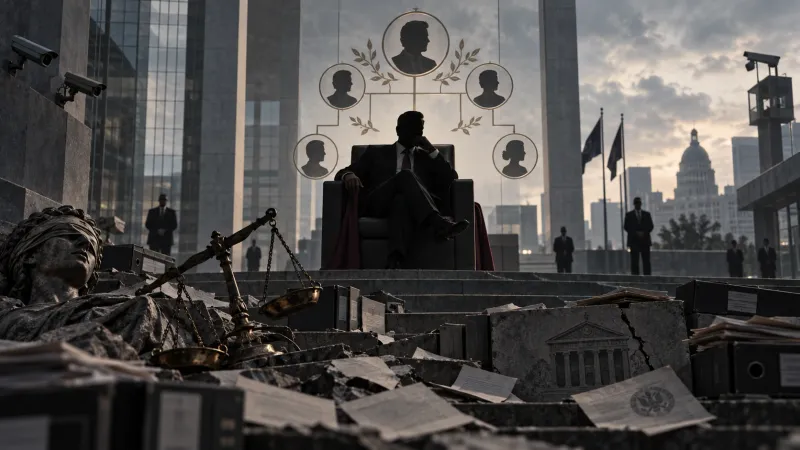
In a political order where the three branches of power are concentrated in a single hand, where checks and balances have been eroded and institutions reduced to mere façades, an almost unlimited capacity to act emerges for the party or individual holding power. Such a structure is always only one step away from degeneration, corruption and the transfer of wealth. It is the political embodiment of the dictum, frequently invoked in recent times: “Power corrupts, and absolute power corrupts absolutely.”
In single-party regimes, and especially in one-man regimes, corruption and the transfer of wealth are organized through a network of relationships centred on the leader. In most cases, the leader’s family also occupies the centre of this network. A judiciary subordinated to the leader provides the perpetrators of corruption with a shield of impunity and protection. Yet, much like a medicine, this network also has a side effect. The relationship is not merely one of complicity in wrongdoing; it also becomes a “mutual hostage network” (Eren, 2026). Public contracts, judicial protection, concealed ties and shared illegalities lock the power bloc together around the leader — and, very often, around the leader’s family as well. Within this network, everyone’s past and actions become leverage in someone else’s hands. Accumulating compromising material and tools of blackmail becomes as important as accumulating wealth.
In such a system, losing power cannot be regarded as an ordinary electoral defeat. For the components of the network, the loss of power becomes an existential question. It increases the likelihood that corruption will be exposed, that members of the network will be prosecuted, and that wealth accumulated through the plunder of state resources will be lost. For those who have, at one point or another, become part of this network, keeping it alive and preventing the loss of power therefore takes precedence over internal contradictions and disputes over the distribution of wealth. Even if an individual is excluded, loses part of their fortune or is forced to spend a period in detention, they will continue to submit to the network as long as the leader at the centre of power retains control.
A further feature that can be observed in recent examples of this type of political structure is the hybridization of state coercion. In a system where corruption and illegality have spread throughout the entire political body like a cancer, not only political rivals but anyone outside the ruling camp becomes a potential risk, simply because they retain the capacity to say that “the emperor has no clothes.” As the range and scale of perceived risks expand, coercive instruments diversify accordingly and can grow to extraordinary proportions. Their scale matters, but what deserves particular emphasis is the diversity that gives this coercive apparatus its character. Traditional mechanisms of coercion — police forces and even counter-guerrilla structures — remain in place, but they may now operate alongside organized crime groups with complex ties to the government, blackmail material based on covert recordings of private lives, and media apparatuses systematically mobilized for character assassination and disinformation. Although these instruments may themselves be fragmented, like the power bloc as a whole, they can when necessary be directed by the leader and his cronies against a single target.
Another characteristic of such political structures is that interests, rather than ideology and principles, become decisive. Ideology and principles are useful only insofar as they serve those interests. The parties representing such governments may initially come to power as carriers of a particular ideology, and may indeed genuinely embody that ideology at first. Yet after a process in which the party increasingly falls under the leader’s domination and important cadres are removed, it turns into a hostage network held together by shared interests and complicity, and from there into a broader power bloc or coalition of alliances centred on the leader. By the end of this process, ideology itself becomes a “shirt” that can be changed and discarded. For a leader who controls the entire state apparatus, saying the exact opposite today of what was said yesterday — and still being applauded by voters who have been transformed from an electorate into a loyal following — is generally not very difficult.
In such a mechanism, where ideological consistency and principles come after interests, the leader removes all potential alternatives within the party or the broader power bloc whom he regards as rivals or threats, or binds them to himself through the distribution of status and wealth. Yet one of the weakest points of this mechanism is, once again, the leader himself. It is the leader who brought this power and this network into being. As the sole source of authority and the arbiter of disputes and conflicts, his advancing age or deteriorating health raises the question of succession.
For the leader, succession resembles an equation with three unknowns: Which heir can preserve power? Around whom can all components of the ruling bloc unite? Who can fully eliminate the risk of prosecution and the confiscation of wealth? Examples show that in systems where the leader has constructed a new political order and a new network of power, the question of succession is predominantly addressed through blood ties (Brownlee, 2007). Establishing a dynasty is, after all, the safest way to keep wealth acquired through the state within the family (Chayes, 2020). Some scholars describe family-based regimes operating under republican forms as “dynastic republics” (Yates, 2017, 2019).
When such governments perceive themselves to be under threat, or when the question of succession comes to the fore, the limits of what they may be prepared to do become increasingly uncertain. Repression, violence and unethical methods once regarded as unthinkable may suddenly become possible: mass arrests, massacres, threats directed at the freedom and future of spouses and children, manipulation through the media, years of imprisonment based on entirely fabricated accusations, the use of intimate recordings to force individuals out of politics, and political assassinations disguised as ordinary crimes…
Another reflex in moments of crisis is the formation of sudden and shifting alliances. On the one hand, the government attempts to eliminate certain threats through repression; on the other, it seeks to strengthen its own front by drawing in everyone it can from within its own political camp and recruiting figures from opposing camps wherever possible. It may also form alliances specifically in order to divide the opposition. Yet the ruling bloc’s primary motivation in such arrangements is almost always its own interest. Grandiose and bombastic rhetoric endlessly reproduced through the media does not alter this reality. Alliances remain meaningful for the leader and his cronies only for as long as they serve their interests and/or until the perceived risk disappears. Given the fragmented nature of opposition forces, a government that must confront multiple political actors simultaneously has a clear incentive to divide the opposition or neutralize parts of it. At times this may be achieved through alliances; at others, one section of the opposition may be demonized through labels such as “terrorist” and rendered so politically toxic that no one can stand by them. Agamben’s concept of “bare life” may offer one useful association here (2020).
It is unrealistic to expect principled or restrained conduct from corrupt governments that possess absolute power. This is particularly so when the question of succession — potentially an existential crisis for the regime — emerges. At such moments, almost any argument may be deployed at the level of political rhetoric. Democratic discourse of any kind emerging from within the ruling bloc or its broader political camp serves no purpose other than setting the agenda, buying time, neutralizing parts of the opposition through alliances, or preparing political cover for other instruments of repression and attack.
When a succession crisis overlaps with an electoral crisis — a decline in votes — the political order embodied by the leader and his cronies requires “mega-projects,” whether physical or political, through which they can preserve their continued existence, either at the level of rhetoric or, where necessity and opportunity permit, in practice. Such projects can also create the conditions for transformations capable of determining the future of entire countries. For the leader and his cronies, the most desirable outcome is to use every available means — including such mega-projects — to secure the transmission of power through bloodline, and, if possible, to accomplish this outside the framework of elections altogether: monarchy. For this purpose, “the end justifies the means.” In such regimes, the dynastic option is pursued to its limits. When it becomes clear that this is no longer possible, the transfer of power is instead attempted in exchange for guarantees that the leader and his family will not be prosecuted and that their assets will not be confiscated.
For this type of regime, dynastic succession is not a preference but an imperative. Yet the fact that it is an imperative does not mean that it will necessarily succeed. Whether the network can be transferred smoothly to the next generation, or whether the ruling group can find a “safe” exit, ultimately depends on the same variable: the strength and unity of the opposition confronting it. What becomes decisive, therefore, is not what those in power wish to do, but what kind of force can be organized against them.
Translation Note: This English translation was prepared with the assistance of artificial intelligence and subsequently reviewed, edited, and approved by the author. The author assumes full responsibility for the accuracy and final wording of the translation.
References
Agamben, Giorgio. (2020). Kutsal İnsan: Egemen İktidar ve Çıplak Hayat [Homo Sacer: Sovereign Power and Bare Life] (trans. İ. Türkmen). Ayrıntı Yayınları. (Original edition 1995)
Brownlee, Jason. (2007). “Hereditary Succession in Modern Autocracies.” World Politics, 59(4), 595–628.
Chayes, Sarah. (2020). On Corruption in America: And What Is at Stake. New York: Knopf.
Eren, Mustafa. (2026). “Türkiye’de Rejim Dönüşümünü Yeniden Düşünmek” [Rethinking Regime Transformation in Turkey]. Birikim, 448, August 2026, 17–36.
Yates, Douglas A. (2017). “Dynastic Rule in Equatorial Guinea.” African Journal of Political Science and International Relations, 11(12), 339–359.
Yates, Douglas A. (2019). “The Dynastic Republic of Gabon.” Cahiers d’études africaines, 234, 483–513. Retrieved 3 September 2026, from https://journals.openedition.org/etudesafricaines/25961