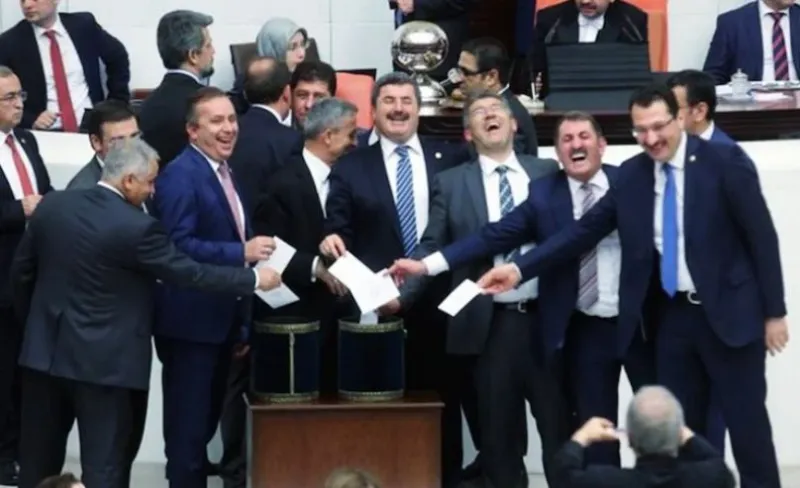
The transfer of the Üsküdar mayoralty to the AKP, and what we have seen and what has been alleged throughout that process, constituted one of the latest and most extreme examples of what we have been witnessing—and being subjected to—for quite some time. In the last local elections, the CHP won 49.9 percent of the vote, finishing first and leading the AKP by approximately 24,000 votes. Mayor Sinem Dedetaş was subsequently arrested. In a later vote held by the Municipal Council, another CHP member was elected acting mayor. The AKP challenged that election, and a court ordered it to be repeated.
At a time when the CHP held 27 seats on the council while the AKP and MHP together held 17, four CHP council members defected to the AKP. Özgür Çelik, Yeni Parti’s Istanbul provincial chair, stated that one of these four had told him over the phone, in tears, that a prosecutor had threatened to have him arrested and that, because he had a disabled wife and son, he had felt compelled to change parties. Çelik also said that it was being discussed in political circles and on the streets of Üsküdar that a second council member had changed parties in return for the release of his imprisoned son.
The allegation concerning a third council member, according to Çelik, was based on what that person himself had said in front of dozens of council members during the first vote. Çelik stated that the man’s son had been convicted of “membership in a terrorist organisation” and was in exile, and that the Ministry of Justice would make it possible for him to return to the country. As for a fourth council member, allegations that he had received between 500,000 and one million dollars were reported in the press. Another striking allegation in Çelik’s statement was that the four council members had been kept at a hotel under police escort so that their families and relatives could not influence them.
Before the vote scheduled for 5 September, three CHP council members were detained on 2 and 3 September, and two of them were arrested. This brought the balance on the council to 21–21. When CHP and Yeni Parti council members refused to participate in a vote while their colleagues were still in custody, the election was postponed until 8 September. In the vote held on 8 September, the AKP candidate was elected mayor by 23 votes to 19. Çelik also named one of the two people who voted for the AKP candidate and alleged that he had been threatened through his employer by way of the prosecutor’s office; he further stated that other council members had also been summoned by prosecutors.
The result was that, in a district where the CHP candidate had been elected with a lead of roughly 24,000 votes, the mayoralty changed hands amid allegations of threats, blackmail and bribery. And all of this happened in full public view.
This brazenness and heavy-handedness bring to mind so much of what we have lived through over the years, almost like the life of a dying person—democracy—flashing before our eyes.
“My civil servant knows how to get things done.” [Turgut Özal, former prime minister and president of Turkey; a phrase that came to be associated in public debate with informal advantage and corruption.]
“Nothing happens if you breach the Constitution just once.” [Widely attributed to Turgut Özal, former prime minister and president of Turkey.]
“There are ships, and then there are little ships.” [Recep Tayyip Erdoğan, then prime minister of Turkey, responding in 2007 to criticism over his son’s purchase of a ship; later president.]
Başakşehir’s controversial championship.
Money found in shoeboxes in the homes of state officials.
Laughingly refusing to investigate corruption.
Defending a child sexual abuse case by saying that “there was consent.”
Being able to say, in the face of mass abuse, that “nothing happens if it happens just once.”
The appointment of state trustees to elected municipalities.
What happened during the transfer of the Üsküdar mayoralty.
These are, of course, merely the first examples that come to mind. Each is like a hairline crack in a pane of glass. On its own, none may appear to cause serious damage. But as the number of cracks grows, they eventually cause the glass to shatter—seemingly “all by itself.”
The values and unwritten rules that hold a society together are steadily eroding. As recently as twenty-five or thirty years ago, events that would have been condemned or regarded with disapproval are now becoming ordinary, routine and, more importantly, “accepted.” Corruption, disregard for rules and various forms of overriding the electorate’s will certainly existed before, to one degree or another. But they were not as widespread or as large in scale as they are today; they were not carried out with the same degree of brazenness and heavy-handedness; channels of criticism were more open; and such practices were more often concealed rather than placed conspicuously on display.
By now, one threshold after another has been crossed, and spectacle itself has become a means and method of normalisation and acceptance. Unfortunately, many cultural products created with critical intent have, regardless of their critical content or the intentions of their creators, also begun to serve this process.
Perhaps this is also where we should look for an explanation of why a government that controls almost the entire mainstream media and identifies itself as “conservative” remains silent in the face of what morning television programmes pour over us every day.
The objection here does not stem from a position that can simply be dismissed as “moralism.” What is at issue is the erosion of values that cut across differences of religion, nationality and political position and that, at a more fundamental level, constitute the common ground holding society together—and the resulting disintegration of the social fabric.
This loss of values is not, of course, entirely spontaneous. To a large extent, it is injected from above, in small doses, repeatedly and through each new practice. Those who hold power—above all politicians, military officers, bureaucrats, businesspeople and other decision-makers—provide the initial momentum through practices that serve their own interests while disregarding rules, sanctions and ethical constraints. Like a stone thrown into water, these acts reverberate through society. And as those reverberations grow, so does the scale of what those in power are able to do.
At this point, it might be tempting to identify “society as a whole, increasingly becoming the perpetrator” as the culprit. But that would be an easy and misleading answer. This arbitrariness, coercion and shamelessness cannot be sustained or spread in waves without impunity. In no political order where those in power refuse to tolerate such practices can they find the conditions necessary to become widespread and normalised. The principal responsibility therefore lies with political power itself, which keeps this acceleration alive through impunity.
No society can continue to live together in a predictable and reliable way once the number of hairline cracks becomes too great. As shared values disappear, they are replaced by the logic of “every man for himself”—the Turkish expression gemisini kurtaran kaptan, literally, “the captain who saves his own ship.” Every system of values produces its own average human type.
The response, “Am I the only sucker?”, becomes a way of “rationally” adapting to the new reality. And eventually, that adaptation itself becomes normal. That is how social disintegration begins.
In the short term, those who benefit from rule-breaking may believe that they are winning. But trust, fairness, the binding force of one’s word and of rules, and respect for election results are not merely formal ornaments that protect the victims. They are the load-bearing pillars of society. A society that erodes them ultimately destroys the very ground on which it stands.