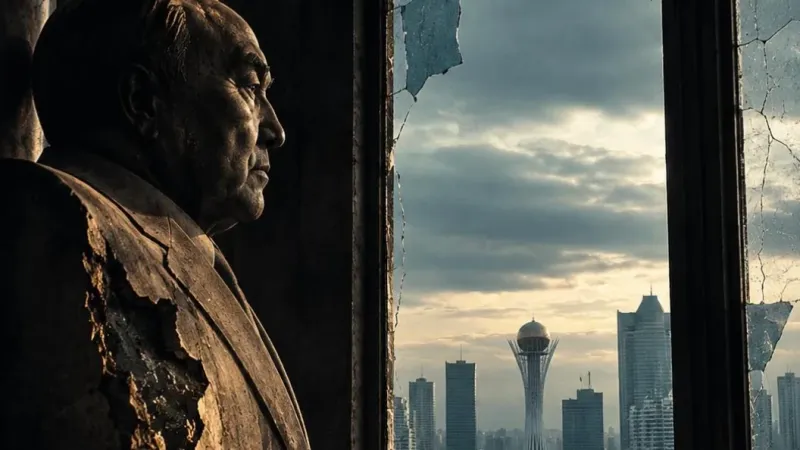
In the article “The Dynastic Imperative of Corrupt and Personalized Regimes,” I argued that dynasticization is not a choice but a necessity for corrupt and increasingly personalized regimes, although the fact that it is necessary does not mean that it will necessarily succeed. Kazakhstan under Nursultan Nazarbayev is one of the clearest examples of this distinction.
Nursultan Nazarbayev was elected President of Kazakhstan in 1990, before the dissolution of the Soviet Union, and remained in power after the country declared independence in 1991. He ruled the country for more than three decades, until announcing his resignation in 2019.
Having led the country since the dissolution of the Soviet Union, Nazarbayev is also described as its “founding leader.” Following the 1991 election, he was re-elected president in 1999 and 2005. However, the Constitution permitted only two presidential terms. A constitutional amendment subsequently cleared the way for him to run again in the 2011 and 2015 elections, allowing him to secure two additional terms (BBC, 2019).
Nazarbayev began concentrating power around himself during his earliest years in office. Following the parliamentary crises arising from the 1993 Constitution, a new constitution adopted by referendum in 1995 established a “super-presidential” system that, despite formally resting on the separation of powers, granted the president overwhelming authority in practice. As president, Nazarbayev maintained a loyal majority in the Senate and possessed the power to dissolve a parliament he considered uncooperative (Mallinson, 2023). He also chaired the ruling Nur Otan party and exercised decisive influence over the judiciary and senior state appointments. Positions granting him lifelong privileges were introduced later. Under the 2000 Law on the First President, he became a lifelong member of the Security Council and the Constitutional Council (Silvan, 2020). In 2018, he also secured the lifelong chairmanship of the Security Council (RFE/RL, 2018).
Within the state structure headed by Nazarbayev, his three daughters, sons-in-law and several other relatives occupied key positions. Timur Kulibayev, the husband of his middle daughter Dinara, chaired the board of Samruk-Kazyna, the sovereign wealth fund that brought together state-owned enterprises ranging from the oil and gas giant KazMunayGas to the national railway company and accounted for approximately a quarter of the country’s economy. Dimash Dosanov, the husband of his youngest daughter Aliya, headed the national oil transportation company KazTransOil, while Kairat Sharipbayev, the partner of his eldest daughter Dariga, managed the national gas company QazaqGaz. Dariga herself held senior parliamentary positions for many years. Nazarbayev’s nephew Kairat Satybaldy represented the family’s influence within the security apparatus. He served with the rank of major general in the National Security Committee (KNB), the country’s intelligence agency, and held a stake of approximately 30 percent in the national telecommunications company Kazakhtelecom. He also served for a period as deputy governor of Astana. In addition, Kulibayev and Dinara controlled Halyk, the country’s largest bank. According to Forbes, the couple’s combined wealth reached approximately $8 billion (Lillis, 2023). A WikiLeaks document described Kulibayev as a figure who controlled 90 percent of the Kazakh economy (Fayzullina, 2013).
Corruption allegations involving Nazarbayev began appearing in Western media in 1999. According to these reports, Nazarbayev held millions of dollars in Swiss bank accounts. Similar allegations appeared in 2002 in Respublika, one of Kazakhstan’s opposition newspapers. Following these reports, the newspaper’s journalists received death threats and its offices were set on fire. The newspaper was eventually shut down in 2012 (BBC, 2019).
The allegations concerning millions of dollars held in Swiss banks became the subject of a US investigation in 2003. The case involved claims that American businessman James Giffen, Nazarbayev’s chief oil negotiator, who had been appointed an “adviser to the President of Kazakhstan” in 1995, had paid millions of dollars in bribes to Kazakh officials. According to prosecutors, between 1995 and 2000, more than $80 million obtained from four American oil companies in exchange for oil agreements was transferred into Swiss bank accounts belonging to President Nazarbayev, Prime Minister Nurlan Balgimbayev and other state officials (RFE/RL, 2010). Known as Kazakhgate, the case was one of the largest foreign bribery cases in US history at the time. The proceedings ended in 2010. Nazarbayev was identified in the indictment as an “unindicted co-conspirator” and was protected by presidential immunity. After arguing that he had worked for the CIA, Giffen pleaded guilty to a single tax offence and was released without a prison sentence or fine, paying only a mandatory $25 court assessment. His company, Mercator, admitted to an FCPA violation involving two snowmobiles and was fined $32,000 (Stanford Law School; Lillis, 2010). Approximately $84 million frozen in Switzerland was transferred in 2007 to the BOTA Foundation, established to support disadvantaged children and young people, under an agreement between Kazakhstan, the United States and Switzerland facilitated by the World Bank (World Bank, 2007; Swiss Confederation, 2015).1
Nazarbayev’s name was also associated with suspicious deaths. During the years when the Kazakhgate case was attracting attention, the official explanations concerning the deaths of opposition leaders Zamanbek Nurkadilov in 2005 and Altynbek Sarsenbayev in 2006 were regarded as suspicious by many observers (Lillis, 2009).
Accounts of Nazarbayev have oscillated between portraying him as the “father of the nation,” who built the country after the dissolution of the Soviet Union and presided over an economic success story, and as “an autocrat who oversaw a transition to a kleptocracy driven by rapid enrichment.” Yet the concrete developments make it possible to assess the situation. Through the 2000 Law on the First President, a title referring to his status as founding leader, Nazarbayev granted himself and his family lifelong immunity from prosecution for all offences except treason. In 2010, constitutional provisions and amendments to the 2000 Law on the First President conferred upon him the status of Elbasy, meaning “Leader of the Nation,” further strengthening the immunity enjoyed by Nazarbayev and his family (RFE/RL, 2023).
As legal proceedings were initiated against him, corruption allegations appeared in both domestic and foreign media, and his name became associated with suspicious deaths, the questions of succession and a secure exit from power became increasingly pressing for Nazarbayev.
The First Son-in-Law’s Premature Struggle for Succession and Tragic End
One of the first serious candidates to succeed Nazarbayev was Rakhat Aliyev, the husband of his eldest daughter, Dariga. Aliyev was no ordinary presidential son-in-law. He had held key positions within the state, ranging from the tax administration and the deputy chairmanship of the National Security Committee to the post of deputy foreign minister and the ambassadorship in Vienna. Together with Dariga, he had also built a powerful media presence through their influence over television channels and newspapers. By the mid-2000s, the couple were among the leading contenders to succeed Nazarbayev (Najibullah, 2007).
Yet it was precisely this position that began to create problems for Aliyev. No longer content with being considered a possible successor, he made his own political ambitions explicit. According to statements he later made, he told Nazarbayev that he wanted to run for president in the future. He also opposed the constitutional amendment that removed the term limit preventing Nazarbayev from seeking re-election. Thus, a potential heir became an independent centre of power and a possible rival in Nazarbayev’s eyes (Najibullah, 2007).
In 2007, these tensions developed into open conflict. An investigation was launched against Aliyev over the kidnapping of two Nurbank executives. Aliyev claimed that the real reason for the investigation was his presidential ambitions. Shortly afterwards, he was dismissed from his position as ambassador to Vienna, further legal proceedings were initiated against him, and his marriage to Dariga ended. During the investigations, Aliyev sought refuge in Austria, where he had previously served as ambassador.
Amid these developments, which could be seen as an internal power struggle, audio recordings were also turned into political weapons. Following the emergence of allegations against Aliyev, several recordings allegedly concerning multimillion-dollar bribes and involving senior Kazakh government officials, including what was said to be Nazarbayev’s voice, were leaked to opposition websites. In the wake of these leaks, legislative measures were proposed in Kazakhstan to regulate websites and allow them to be blocked when deemed necessary (Pannier, 2008).
Kazakhstan requested Aliyev’s extradition to stand trial, but Austria rejected the request on the grounds that he would not receive a fair trial in Kazakhstan (Pannier, 2007). During the legal proceedings, charges of “treason” and “plotting a coup” were added to the accusations against him. Aliyev was sentenced in absentia to a total of 40 years in prison in two separate trials in Kazakhstan (Pannier, 2008).
Aliyev’s story ended tragically. Following an investigation launched by Austrian authorities into the alleged murder of the Nurbank executives, he was arrested in 2014. While the proceedings were still underway, he was found dead in his cell at Josefstadt Prison in Vienna in February 2015. Austrian authorities declared his death a suicide, but Aliyev’s lawyer, Klaus Ainedter, expressed “serious doubts” that his client had taken his own life and called for a thorough investigation (RFE/RL, 2015).2
Aliyev’s struggle for succession, which he had initiated by stepping outside the line of succession determined by Nazarbayev, ended in exile and a disputed death.
The Second Son-in-Law’s Bid for Succession and Removal
Aliyev’s removal did not eliminate the dynastic option. It merely took the first powerful son-in-law out of the equation. Nazarbayev still had other possible successors within the family: his other son-in-law, Timur Kulibayev, and his three daughters.
Following Rakhat Aliyev’s removal, the second son-in-law to emerge in discussions of succession was Timur Kulibayev, the husband of Nazarbayev’s middle daughter, Dinara. Kulibayev’s power differed from Aliyev’s. Rather than being rooted in the security apparatus, his influence lay at the centre of the economy. He had risen through the oil and gas sector before taking charge of Samruk-Kazyna, which brought together the country’s major state-owned enterprises. In July 2011, Nazarbayev’s adviser Yermukhamet Yertysbayev stated that Kulibayev could continue the president’s strategic course if Nazarbayev unexpectedly left office (Najibullah, 2011). The statement itself indicates that, at the time, at least part of the bureaucracy regarded Kulibayev as a potential successor. Some commentators also suggested that Nazarbayev had prompted the statement to gauge the reactions of other components of the ruling bloc (RFE/RL, 2011a).
Kulibayev’s political rise, however, was short-lived. In December 2011, a workers’ strike that had continued for months in the western oil town of Zhanaozen was violently suppressed by security forces. According to official figures, at least 15 people were killed. The incident triggered protests across Kazakhstan. A few days later, Nazarbayev visited the region and placed responsibility on the regional governor, the oil companies and the management of Samruk-Kazyna, the public institution overseeing them. He subsequently removed his son-in-law from the chairmanship of the organisation (RFE/RL, 2011b). Kulibayev thus lost his position at the head of the state-controlled economy, while his prominence in succession discussions also diminished. However, according to Freedom House’s 2013 assessment, Kulibayev’s dismissal was “largely an attempt to appease the public.” Despite no longer holding an official position, he retained his influence over the country’s economy and his positions within business organisations behind the scenes (Freedom House, 2013).
The Guardian Plan as a Transitional Arrangement
With the first son-in-law having entered the struggle for succession prematurely and the second becoming publicly associated with a massacre, another formula for succession began to emerge. The search for an heir shifted from Nazarbayev’s sons-in-law to his own children, particularly his eldest daughter, Dariga, whose path was gradually cleared as she was appointed to increasingly important positions.
Dariga had already been involved in politics for many years. She had served as deputy prime minister, entered the Senate in 2016 and chaired its Committee on International Relations, Defence and Security.
As protests increased across the country and reports about the health of Nazarbayev, now over 70, repeatedly appeared in the media, Dariga became increasingly prominent in the succession calculations for the post-Nazarbayev period. Although the ruling Nur Otan party had won 82 percent of the vote in the 2016 elections and retained power, the worsening economy, growing income inequality and corruption allegations over the following two years brought people onto the streets. Protests spread throughout the country, with demonstrators generally demanding the government’s resignation. Following the growing wave of protests, the government was dismissed in February 2019 and a new government took office. In March, Nazarbayev’s resignation came onto the agenda (Sağlam, 2019).
The nature of the plan began to reveal itself through the developments that followed Nazarbayev’s resignation. After he stepped down, Kassym-Jomart Tokayev, then Chairman of the Senate, assumed the presidency in accordance with the Constitution. On the same day, Dariga Nazarbayeva was elected to the Senate chairmanship vacated by Tokayev, again at his proposal. This was no ordinary parliamentary position. Under Kazakhstan’s Constitution, the Chairman of the Senate was first in line to assume the presidency if the office became vacant. In other words, as Nazarbayev stepped aside, he entrusted the presidency to a reliable figure from outside the family who had long been part of the regime, while placing his daughter in the constitutional line of succession immediately behind him. Tokayev’s second act was to rename the capital, Astana, Nur-Sultan, after Nazarbayev (RFE/RL, 2019).
Meanwhile, before the resignation, figures such as presidential adviser Adilbek Jaksybekov, who had stood alongside Nazarbayev for decades but was reportedly opposed to Dariga’s possible leadership, had been removed from their positions in an apparent effort to clear her path (Pannier, 2018).
All these developments naturally gave rise to interpretations that Tokayev was a temporary guardian and Dariga the intended ultimate successor (RFE/RL, 2019). After all, although Nazarbayev had resigned from the presidency, he had not withdrawn from power. He retained the chairmanships of the Security Council and the Nur Otan party, which he had founded, as well as his membership of the Constitutional Council (Baumgartner, 2019; Toleukhan, 2019).
However, an unexpected development occurred a year later, in May 2020. Tokayev, who had been regarded as Nazarbayev’s guardian, removed Dariga from her position, and former deputy presidential chief of staff Maulen Ashimbayev was appointed Chairman of the Senate. This was interpreted as “a sign of a possible power struggle at the highest levels of the country’s leadership” and “an indication of political turbulence among competing centres of power” (RFE/RL, 2020).
At this point, the attempt at dynasticization can be said to have reached its first serious limit. Two powerful sons-in-law had been removed from the succession equation, while Nazarbayev’s most politically active daughter had been pushed out of the constitutional line of succession by the very successor chosen from outside the family. Nazarbayev had transferred power, but for the first time it became apparent that his control over the office he had handed over was not as absolute as he had assumed.
The Guardian Takes Control
The balance Nazarbayev had established collapsed amid the protests that erupted in January 2022. Demonstrations that began on 2 January against rising fuel prices quickly spread across the country. Protesters demanded the resignation of the government and Nazarbayev’s removal from his remaining positions. Their main slogan was “Shal, ket!”, meaning “Old man, go!” Violent clashes took place in Almaty, and according to official figures, at least 225 people lost their lives, while nearly 10,000 people were detained (Independent Türkçe, 2022). These events were described by the Kazakh opposition as “Bloody January.”
Tokayev later described the events as an attempted coup involving elements within the state, while Nazarbayev blamed the former energy minister and claimed that the events had been directed from Kyiv (Sputnik, 2023). How the events were organised and the extent to which the internal power struggle contributed to the escalation of violence remain disputed. Their political outcome, however, is clear: Tokayev turned the crisis into an opportunity to seize the principal instruments of power that he had previously been forced to share with Nazarbayev (Reuters, 2022a).
The first move came on 5 January. Tokayev assumed the chairmanship of the Security Council, replacing Nazarbayev, who had retained the position for life despite stepping down from the presidency in 2019. Subsequently, Karim Massimov, the domestic security chief regarded as an important Nazarbayev ally, was arrested on charges of “treason,” while Nazarbayev’s nephew Samat Abish was removed from his position as deputy chairman of the National Security Committee. The removal of Nazarbayev family members was not confined to the security apparatus but extended into the economic sphere. Dariga’s partner Kairat Sharipbayev was forced to step down as head of QazaqGaz, while Dimash Dosanov, the husband of Nazarbayev’s youngest daughter Aliya, lost his position at KazTransOil. A few days later, Timur Kulibayev also resigned from the chairmanship of Atameken, the country’s influential business association. Around the same time, reports emerged that Tokayev had called on Nazarbayev’s relatives to share their wealth with the public by making regular donations to a new charitable foundation (Euronews, 2022; Crisis Group, 2022).
Having taken the chairmanship of the Security Council from Nazarbayev at the beginning of January, Tokayev also assumed the leadership of the Nur Otan party towards the end of the month, completing the “transfer of political power.” At the party congress that elected Tokayev as chairman, Nazarbayev’s eldest daughter Dariga, who was a member of parliament, and several other members were also removed from the political council, stripping them of their influence (Reuters, 2022b).
The decisive blow came a few months later. A constitutional referendum held in June 2022 abolished the constitutional foundations of the special “First President – Elbasy” status granted to Nazarbayev, ending his lifelong membership of the Constitutional Council and other privileges. In January 2023, the Law on the First President – Elbasy was repealed in its entirety, thereby removing the special immunity and property protections that had also extended to Nazarbayev’s family (RFE/RL, 2023).
The case of Nazarbayev’s nephew Kairat Satybaldy provides perhaps the clearest illustration of both the methods and the limits of this transformation. Arrested in March 2022, Satybaldy was sentenced in September of the same year to six years in prison on corruption and embezzlement charges involving Kazakhtelecom and other companies. His assets were confiscated, he was banned from holding public office for ten years, and his rank of major general in the KNB and his state honours were revoked. During subsequent investigations, according to figures released by Kazakh authorities, Satybaldy and associated individuals returned approximately 732 billion tenge, equivalent to $1.6 billion, in funds and assets to the state. These included shares in Kazakhtelecom, stakes in other companies, real estate and assets held abroad (Matveev, 2024; Ismailov, 2024).
In August 2024, Satybaldy was released from prison after the remainder of his sentence was converted into three years and three months of restricted liberty, with compensation for the damage caused and the transfer of assets to the state cited among the reasons (RFE/RL, 2024). Dinara and Timur Kulibayev, meanwhile, continued to retain their considerable wealth. There was no wholesale purge of the Nazarbayev family. Tokayev’s actions can be understood primarily as an effort to break the political power of the former centre of authority, recover some of its wealth and demonstrate that he now had the power to decide who would be protected.
Although Nazarbayev had believed that he had secured legal guarantees for himself and his family during the early 2000s, when his power was at its height, two decades later the titles, positions and laws that provided those guarantees were stripped away one by one. He himself was not imprisoned, nor was his entire family purged. Yet this was not because of the laws he had arranged to have enacted, but because of how far his successor chose to go. Having failed to establish a dynasty, the ruler also lost the power to determine the conditions of his own secure exit from power.
The Ruler Changed, the System Remained
Nazarbayev’s removal from power does not necessarily mean that Kazakhstan has become more democratic. Those who took to the streets in January 2022 demanded a change of government and democracy. The leadership changed, but despite some democratic initiatives, the outcome has raised serious concerns about the emergence of a “new ruler.”
After using the protests to consolidate his control over power, Tokayev introduced some genuine institutional changes under the slogans of “New Kazakhstan” and “Just Kazakhstan.” The president was prohibited from belonging to a political party, close relatives were barred from holding senior government positions or heading quasi-public companies, a Constitutional Court was established, and limited reforms were introduced into the electoral system. However, these changes did not open political power to genuine competition. Restrictions on opposition parties and candidates persisted, as did pressures on media freedom and freedom of assembly. Freedom House continued to classify Kazakhstan as “Not Free” under Tokayev (Freedom House, 2024, 2026).
The nature of Tokayev’s rule can also be examined through his appointments. Under the constitution revised in 2026, Tokayev, much like his predecessor Nazarbayev, reset the count of his presidential terms, clearing the way for another candidacy. At the same time, he appointed Erlan Karin, a longstanding associate, to the re-established office of vice president (Zelinska, 2026; Bilyal, 2026). Another development cast doubt on his stated commitment to keeping family members out of government. Tokayev’s niece Dana Medeuova first joined the political council of the new ruling Adilet party and, following the August elections, entered the Kurultai as a member of parliament (Umarov, 2026; Qazinform, 2026).
The accumulation and transfer of wealth have also become controversial issues surrounding Tokayev’s family. Serious questions remain about the extent and origins of the family’s wealth. According to OCCRP’s 2022 “Suisse Secrets” investigation, members of Tokayev’s family, despite having no known business background or identifiable source of wealth, held Swiss bank accounts from 1998 onwards and offshore shell companies in the British Virgin Islands after 2012. Because Kazakh officials were not required to disclose their assets, the origins of this wealth remained unclear, and the family did not respond to questions (OCCRP, 2022).
The structure of the ruling party itself further supports arguments that no fundamental break has occurred. Although the party’s name has changed, its organisational structure has been preserved. Founded under Nazarbayev’s leadership in 1999 as Otan, the party was renamed Nur Otan in 2006 and Amanat in 2022. In 2026, a new party called Adilet, meaning “justice,” was established to create the impression of a break with the past. In June 2026, Amanat, with approximately 800,000 members, dissolved itself and joined the new party. In the August 2026 elections, Adilet won 110 of the 145 seats and 71.2 percent of the vote (Umarov, 2026; Ismailov, 2026).
Nazarbayev’s attempt to establish continuity through blood ties collapsed, but this led neither to democratisation nor to the complete dismantling of the old structure. Although some initially democratic-looking measures were introduced, numerous critics have argued that only the ruler has changed while the system has remained intact. Subsequent developments have largely confirmed these criticisms.
The events in Kazakhstan can be understood as a fierce transfer of power between ruling factions that exploited a popular uprising for their own purposes, followed by a renewed personalisation of power. The personalised structure of rule, based on plunder and coercion, has reproduced itself independently of its founder.
References
Baumgartner, P. (2019). “Explainer: Kazakh President Nazarbaev Resigns, But Is He Really Leaving?” RFE/RL, March 19, 2019. Accessed September 7, 2026. https://www.rferl.org/a/kazakhstan-explainer-nazarbaev-resigns/29830781.html
BBC (2019). “Nursultan Nazarbayev kimdir?: Kazakistan’ı 28 yıl yöneten rakipsiz lider” [Who Is Nursultan Nazarbayev? The Unchallenged Leader Who Ruled Kazakhstan for 28 Years]. BBC News Türkçe, March 19, 2019. Accessed September 5, 2026. https://www.bbc.com/turkce/haberler-dunya-47629056
Bilyal, T. (2026). “Tokayev’s Former State Adviser Erlan Karin Appointed Kazakhstan’s Vice President.” Euronews, August 31, 2026. Accessed September 8, 2026. https://www.euronews.com/2026/08/31/tokayevs-former-state-adviser-erlan-karin-appointed-kazakhstans-vice-president
Crisis Group (2022). “Behind the Unrest in Kazakhstan.” International Crisis Group, January 14, 2022. Accessed September 8, 2026. https://www.crisisgroup.org/qna/europe-central-asia/kazakhstan/behind-unrest-kazakhstan
Eckel, M. (2021). “British Inquest Says Grandson Of Ex-Kazakh President Nazarbaev Died Of Natural Causes, Cocaine Addiction.” RFE/RL, March 24, 2021. Accessed October 23, 2026. https://www.rferl.org/a/british-inquest-says-grandson-of-ex-kazakh-president-nazarbaev-died-of-natural-causes-cocaine-addiction/31167901.html
Eurasianet (2020). “Kazakhstan: Troubled Nazarbayev Grandson Dies Aged 29.” Eurasianet, August 17, 2020. Accessed October 23, 2026. https://eurasianet.org/kazakhstan-troubled-nazarbayev-grandson-dies-aged-29
Euronews (2022). “Kazakh Ex-Leader’s In-Laws Leave Key Energy Sector Jobs.” Euronews, January 16, 2022. Accessed September 7, 2026. https://www.euronews.com/2022/01/16/us-kazakhstan-nazarbayev-family
Fayzullina, K. (2013). “Kazakhstan: The House That Nazarbayev Built.” Al Jazeera Centre for Studies, July 17, 2013. Accessed September 8, 2026. https://studies.aljazeera.net/en/reports/2013/07/201371774242221773.html
Freedom House (2013). “Nations in Transit.” Freedom House, June 18, 2013. Accessed September 7, 2026. https://www.refworld.org/reference/annualreport/freehou/2013/en/94425
Freedom House (2024). “Kazakhstan: Freedom in the World 2024.” Freedom House. Accessed September 8, 2026. https://freedomhouse.org/country/kazakhstan/freedom-world/2024
Freedom House (2026). “Kazakhstan: Freedom in the World 2026.” Freedom House. Accessed September 8, 2026. https://freedomhouse.org/country/kazakhstan/freedom-world/2026
Gavrilis, G. (2019). “The Reminiscences of James H. Giffen.” Harriman Institute Oral History Project, June 5, 2019. Accessed September 6, 2026. https://oralhistory.harriman.columbia.edu/interview/40
Independent Türkçe (2022). “Kazakistan’daki protesto gösterilerinde 225 kişi hayatını kaybetti” [225 People Killed in Protests in Kazakhstan]. Independent Türkçe, January 15, 2022. Accessed September 7, 2026. https://www.indyturk.com/node/460301/d%C3%BCnya/kazakistandaki-protesto-g%C3%B6sterilerinde-225-ki%C5%9Fi-hayat%C4%B1n%C4%B1-kaybetti
Ismailov, V. (2024). “Nazarbayev’s Nephew Returns $1.6 Billion to Kazakhstan Following Embezzlement Conviction.” The Times of Central Asia, August 13, 2024. Accessed September 7, 2026. https://timesca.com/nazarbayevs-nephew-returns-1-6-billion-to-kazakhstan-following-embezzlement-conviction/
Ismailov, V. (2026). “Final Results Give Adilet 110 Seats in Kazakhstan’s Kurultai.” The Times of Central Asia, August 25, 2026. Accessed September 8, 2026. https://timesca.com/kazakhstan-kurultai-election-adilet-wins-71-percent/
KazTAG (2020). “Aisultan Nazarbayev, Who Died in London, Expressed Fears for His Life.” KazTAG, August 17, 2020. Accessed October 23, 2026. https://kaztag.kz/en/news/aisultan-nazarbayev-who-died-in-london-expressed-fears-for-his-life
Lillis, J. (2009). “Kazakhstan: President Nazarbayev Marks Two Decades in Power.” Eurasianet, June 19, 2009. Accessed September 6, 2026. https://eurasianet.org/kazakhstan-president-nazarbayev-marks-two-decades-in-power
Lillis, J. (2010). “Kazakhgate Bribery Saga Fizzles Out amid Claims of Cold War Heroism.” Eurasianet, November 23, 2010. Accessed October 23, 2026. https://eurasianet.org/kazakhgate-bribery-saga-fizzles-out-amid-claims-of-cold-war-heroism
Lillis, J. (2023). “Kazakhstan: Nazarbayev Relatives Mull Reducing Share in Major Bank.” Eurasianet, January 30, 2023. Accessed September 8, 2026. https://eurasianet.org/kazakhstan-nazarbayev-relatives-mull-reducing-share-in-major-bank
Mallinson, K. (2023). “Kazakhstan: Tested by Transition.” Chatham House, July 20, 2023. Accessed September 8, 2026. https://www.chathamhouse.org/2019/11/kazakhstan-tested-transition/2-governance
Matveev, A. (2024). “Out With the Old and in With the New: From Politicians to Felons: Part Two.” The Times of Central Asia, November 19, 2024. Accessed September 7, 2026. https://timesca.com/from-politicians-to-felons-part-two/
Najibullah, F. (2007). “Kazakhstan: Critics Question Presidential Son-In-Law’s Volte-Face.” RFE/RL, May 28, 2007. Accessed September 7, 2026. https://www.rferl.org/a/1076761.html
Najibullah, F. (2011). “Kazakhstan’s ‘Gray Cardinal’ Anoints Presidential Heir Apparent.” RFE/RL, July 25, 2011. Accessed September 7, 2026. https://www.rferl.org/a/chaikhana_kazakhstan_heir_apparent/24276380.html
OCCRP (2022). “The Offshore Secrets of Kazakhstan’s President Tokayev.” Suisse Secrets, Organized Crime and Corruption Reporting Project, February 20, 2022. Accessed September 8, 2026. https://www.occrp.org/en/project/suisse-secrets/the-offshore-secrets-of-kazakhstans-president-tokayev
Pannier, B. (2007). “Kazakhstan: Criminal Scandal Widens Around Ex-Ambassador Aliev.” RFE/RL, August 28, 2007. https://www.rferl.org/a/1078389.html
Pannier, B. (2008). “Kazakhstan: President’s Former Son-In-Law Offers To Testify In ‘Kazakhgate’ Probe.” RFE/RL, May 17, 2008. Accessed September 7, 2026. https://www.rferl.org/a/1117505.html
Pannier, B. (2018). “Kazakhstan: A Falling Presidential Confidant And A Rising Presidential Daughter.” RFE/RL, September 24, 2018. Accessed September 7, 2026. https://www.rferl.org/a/qishloq-ovozi-kazakhstan-falling-presidential-confidant-rising-presidential-daughter-darigha-jaksybekov/29507085.html
Qazinform (2026). “Kazakhstan’s Qurultay and OSCE PA Discuss Climate and Water Security.” Qazinform, October 20, 2026. Accessed October 23, 2026. https://qazinform.com/news/kazakhstans-qurultay-and-osce-pa-discuss-climate-and-water-security-dc9d8c/amp
Reuters (2022a). “Kazakh Leader Removes Veteran Ex-President from Key Security Post.” Reuters, January 5, 2022. Accessed September 7, 2026. https://www.reuters.com/world/asia-pacific/kazakh-leader-removes-veteran-ex-president-key-security-post-2022-01-05/
Reuters (2022b). “Kazakh President Tokayev Takes Over as Ruling Party Leader.” Reuters, January 28, 2022. Accessed September 7, 2026. https://www.reuters.com/world/europe/kazakh-president-tokayev-takes-over-ruling-party-leader-2022-01-28/
RFE/RL (2010). “After Seven Years, ‘Kazakhgate’ Scandal Ends With Minor Indictment.” RFE/RL, August 10, 2010. Accessed September 5, 2026. https://www.rferl.org/a/After_Seven_Years_Kazakhgate_Scandal_Ends_With_Minor_Indictment_/2123800.html
RFE/RL (2011a). “Adviser Backs Away From Nazarbaev’s Succession Comments.” RFE/RL, July 28, 2011. Accessed September 7, 2026. https://www.rferl.org/a/kazakh_adviser_backs_away_comments_on_nazarbaev_successor/24279296.html
RFE/RL (2011b). “President Visits Troubled West Kazakhstan, Fires Officials.” RFE/RL, December 22, 2011. Accessed September 7, 2026. https://www.rferl.org/a/kazakh_gas_chief_fired_as_president_responds_to_recent_clashes/24430297.html
RFE/RL (2015). “Rakhat Aliev, Kazakh President’s Former Son-In-Law, Found Dead In Austrian Jail.” RFE/RL, February 24, 2015. Accessed September 7, 2026. https://www.rferl.org/a/rakhat-aliev-kazakhstan-found-dead-austrian-jail/26865793.html
RFE/RL (2018). “Nazarbaev Becomes Security Council’s Chairman For Life.” RFE/RL, July 12, 2018. Accessed September 8, 2026. https://www.rferl.org/a/kazakhstan-nazarbaev-security-council-chairman-for-life/29358887.html
RFE/RL (2019). “Nazarbaev’s Daughter Handed Powerful Senate Post As Kazakhstan Gets New President.” RFE/RL, March 20, 2019. Accessed September 7, 2026. https://www.rferl.org/a/toqaev-sworn-in-kazakh-president-nazarbaev/29831419.html
RFE/RL (2020). “Election Of New Kazakh Parliament Speaker Sparks Talk Of Power Struggle.” RFE/RL, May 4, 2020. Accessed September 7, 2026. https://www.rferl.org/a/election-of-new-kazakh-parliamentary-speaker-sparks-talk-of-power-struggle/30591896.html
RFE/RL (2023). “Kazakhstan’s Constitutional Court Nixes Law On First President-Leader Of Nation.” RFE/RL, January 11, 2023. Accessed September 7, 2026. https://www.rferl.org/a/kazakhstan-nazarbaev-law-annulled/32218636.html
RFE/RL (2024). “Prison Term Of Kazakh Ex-President’s Nephew Replaced By Suspended Sentence.” RFE/RL, August 19, 2024. Accessed September 7, 2026. https://www.rferl.org/amp/qairat-satybaldy-prison-suspended-sentence-nazarbaev-nephew/33084292.html
Sağlam, M. (2019). “30 yıldır iktidardaki Nazarbayev’in istifası sürpriz değil” [Nazarbayev’s Resignation after 30 Years in Power Comes as No Surprise]. Gazete Duvar, March 19, 2019. Accessed September 7, 2026. https://www.gazeteduvar.com.tr/dunya/2019/03/19/30-yildir-iktidardaki-nazarbayevin-istifasi-surpriz-degil
Silvan, K. (2020). “Managed Leadership Succession in Kazakhstan.” FIIA, March 2020. Accessed September 8, 2026. https://fiia.fi/en/publication/managed-leadership-succession-in-kazakhstan
Sputnik (2023). “Nazarbayev: Ocak 2022’de Kazakistan’da yaşanan protesto olayları Kiev’den yönetildi” [Nazarbayev: The January 2022 Protests in Kazakhstan Were Directed from Kyiv]. Sputnik Türkiye, December 1, 2023. Accessed September 7, 2026. https://anlatilaninotesi.com.tr/20231201/nazarbayev-ocak-2022de-kazakistanda-yasanan-protesto-olaylari-kievden-yonetildi-1077992120.html
Stanford Law School (n.d.). “United States v. Giffen; Mercator Corporation.” FCPA Enforcement Action Dataset. https://fcpa.stanford.edu/enforcement-action.html?id=73
Swiss Confederation (2015). “Restitution of Stolen Assets to Kazakhstan Successfully Completed.” Swiss Confederation, December 9, 2015. https://www.admin.ch/en/nsb?id=59867
Toleukhan, A. (2019). “Kazakistan’ın Sovyet döneminden kalan son cumhurbaşkanının ani istifası halkım için ne anlama geliyor?” [What Does the Sudden Resignation of Kazakhstan’s Last Soviet-Era President Mean for My People?]. Independent Türkçe, March 23, 2019. Accessed September 7, 2026. https://www.indyturk.com/node/20146/d%C3%BCnyadan-sesler/kazakistan%C4%B1n-sovyet-d%C3%B6neminden-kalan-son-cumhurba%C5%9Fkan%C4%B1n%C4%B1n-ani-istifas%C4%B1
Umarov, T. (2026). “Where Are President Tokayev’s Political Reforms Leading Kazakhstan?” Carnegie Politika, July 22, 2026. Accessed September 8, 2026. https://carnegieendowment.org/russia-eurasia/politika/2026/07/kazakhstan-constitution-new-tokaev
World Bank (2007). “Frozen Funds to Help Kazakh Youth under New International Agreement.” World Bank, May 3, 2007. https://documents1.worldbank.org/curated/en/099446205272235036/pdf/IDU0b0c5eab409e1704ab30a63c0c70d7f77b48d.pdf
Zelinska, D. (2026). “Kazakhstan’s New Constitution: Preparations for Succession and the Façade of Democratisation.” OSW, March 18, 2026. Accessed September 8, 2026. https://www.osw.waw.pl/en/publikacje/analyses/2026-03-18/kazakhstans-new-constitution-preparations-succession-and-facade
Footnotes
-
In an extensive oral history interview conducted in 2019, James H. Giffen recounted these events in detail. The interview is particularly valuable for understanding the relationships Giffen developed with Nazarbayev from the early years of Kazakhstan’s independence and the CIA’s activities in the region. Towards the end of the interview, Giffen’s remarks about Ukraine, which is now at war with Russia, are striking: “… If I can change the Ukrainian government, then that will be something. […] Today, I’m involved in the Ukrainian situation. I’ve already put a plan together on how to change the Ukrainian government. It’s in charts, and it’s ready to go.” (Gavrilis, 2019). ↩
-
Aliyev’s death was not the only such case involving a member of the family abroad. Aliyev’s son Aisultan Nazarbayev (Nazarbayev’s grandson) also died in London on 16 August 2020, at the age of 29 (Eurasianet, 2020). Before his death, Aisultan had made numerous statements against his family and the regime. In February 2020, he announced that he was seeking political asylum in the United Kingdom, claiming that his life was in danger (KazTAG, 2020). However, according to the forensic report issued after his death, he died of natural causes related to cocaine use (Eckel, 2021). ↩